Lorem ipsum dolor sit amet, consectetur adipiscing elit. Ut elit tellus, luctus nec ullamcorper mattis, pulvinar dapibus leo.
In healthcare settings, professionals such as patient care technicians (PCTs), often referred to as patient care techs, and certified nursing assistants (CNAs) play a vital role within the facility.
They provide complete support to patients and help ensure their comfort and well-being.
While both roles share many similarities, there are key differences that set them apart.
In this blog, we will know about what each role involves, including their similarities, differences, and how they impact patient care.
By understanding these roles, you can get a clearer idea of which path might be the best fit for your career and how each role helps support patients throughout their healthcare journey.
From this blog, you will also know about the day-to-day responsibilities of each role and how they differ.
Knowing these will be a useful resource whether you are exploring a career or thinking of a transition into patient care tech jobs or clinical support roles.
Who is a certified nurse assistant (CNA)?
Certified nurse assistants (CNAs) typically need a high school diploma or equivalent.
They must complete a state-approved training program that usually lasts 4 to 12 weeks.
It includes both classroom training and hands-on clinical experience. After completing the training, CNAs must pass a certification exam to become licensed to work in their state.
Continuing education may also be required for CNA positions to maintain certification, ensuring they stay up to date on the latest care practices.
Who is a patient care technician (PCT)?
PCTs, commonly known as patient care techs, have more extensive training than CNAs.They need a high school diploma or GED, followed by completion of a PCT certification program.
This certification typically takes 6 months to a year to complete. The PCT program includes specialized training in areas such as EKGs, phlebotomy (blood drawing), and monitoring, as well as general care skills.
PCTs may also be required to obtain certification in CPR or other medical procedures. While certification requirements vary by state, many employers prefer or require PCTs to be certified in their specific area of expertise, such as EKG or phlebotomy.
Similarities between patient care technicians and CNAs
Even though CNAs and Patient care technicians are different roles, they do share a few similarities in their work. Those similarities are clearly explained below.
CNA and PCT roles share many similarities in fundamental patient care.
Both require strong communication, empathy, and the ability to assist with basic tasks such as bathing and eating.
This overlap makes transitioning between the two positions relatively easy, and additional training enhances a patient care tech’s technical skills.
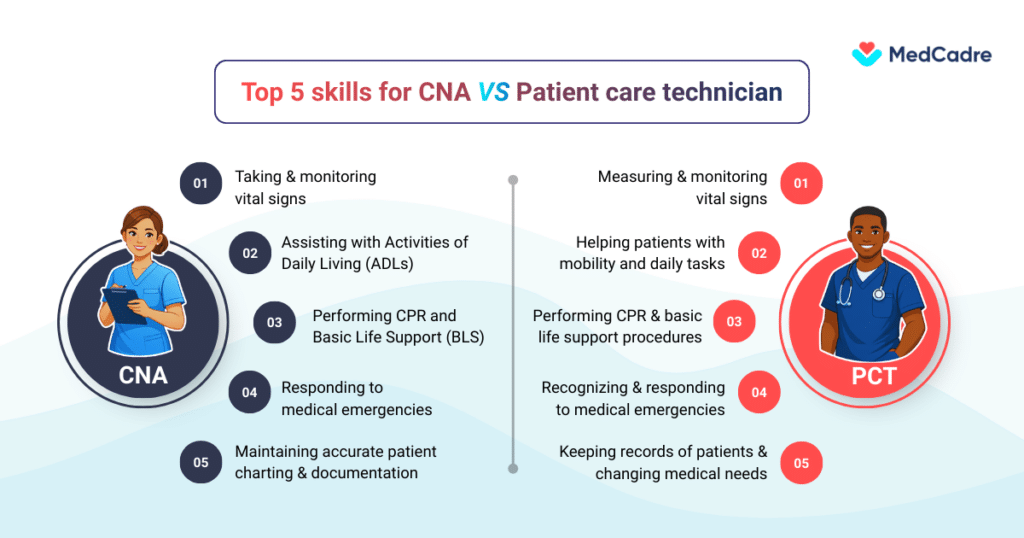
A detailed infographic has been added to highlight the similar skills between the two roles.
Providing direct patient care
PCTs and CNAs provide direct patient assistance in facilities with daily activities such as bathing, dressing, feeding, and mobility assistance.
They ensure patients’ comfort, safety, and hygiene. Professionals working as CNAs or PCTs play an essential role in maintaining patient dignity during daily routines.
Monitoring of vital signs
PCTs and CNAs monitor and record patients’ vital signs, such as blood pressure, pulse rate, temperature, and respiratory rate.
They use this information to assess patients’ overall health and identify any signs of deterioration. This responsibility is central to both patient care tech and nursing assistant roles.
Providing assistance in medical procedures
PCTs and CNAs assist healthcare providers with various procedures, including wound care, specimen collection, and basic patient assessments.
They prepare patients for procedures and offer support during and after the process. These responsibilities are frequently outlined in job descriptions for CNA jobs and similar clinical support roles.
Advocating for patients during treatments
PCTs and CNAs advocate for patients by communicating their needs and preferences to the healthcare team.
They listen to patients’ concerns, provide emotional support, and report any changes in their condition to the nursing staff. Both a CNA and a PCT act as a communication bridge between patients and nurses.
How do these healthcare roles differ from each other?
The main difference between a patient care technician (PCT) and a certified nurse assistant (CNA) lies in the level of clinical responsibilities they handle.
CNAs primarily provide basic nursing care and assist patients with activities of daily living (ADLs). While the patient care tech may perform additional clinical tasks such as EKG monitoring, phlebotomy, and basic laboratory support.
As for salaries, they vary widely by state, facility type, and level of experience.
In the USA, PCTs typically earn higher salaries than CNAs because of their expanded clinical responsibilities and additional training
Scope of practice difference
While CNAs primarily focus on providing basic nursing care and assistance with ADLs, PCTs have a broader scope of practice that may include additional responsibilities such as phlebotomy, EKG monitoring, and basic laboratory procedures. PCTs often receive additional training and certification in these specialized areas
Salary difference
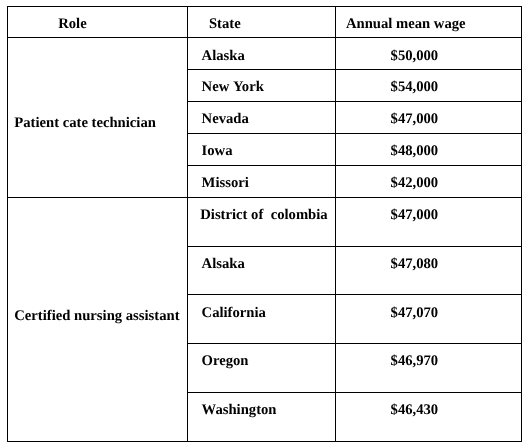
Salary differences are crucial for understanding the key distinctions between these two roles and their respective responsibilities. especially if you plan to apply for CNA jobs and PCT jobs.
To provide a clearer insight into how these differences manifest, an infographic has been included for a detailed comparison of both positions. Use this infographic as a reference point for effective salary negotiation when discussing compensation with employers.
Top-paying states for CNAs and patient care technicians
PCT vs CNA: Which role is right for you?
If you are an experienced professional who is considering a career change, understanding the differences between patient care technicians (PCTs) and certified nursing assistants (CNAs) is vital.
You must understand that both roles are essential in healthcare, providing compassionate, patient-centered care, but they differ in important ways.
The differences are in responsibilities, scope of practice, and career opportunities.
As you explore your options, you may begin by researching CNA jobs near you to understand the physical demands, self-care, and hiring requirements in your area.
Then, you must consider factors such as required training, day-to-day tasks, whether you can maintain work-life balance, and long-term growth potential to determine which role best aligns with your career goals
Select the right role with the help of the right platform
As a working professional, understanding the differences between patient care technicians (PCTs) and certified nursing assistants (CNAs) is important. Each role has different responsibilities and career paths.
These differences affect your daily work and future growth. Knowing them helps you choose a role that fits your skills and requirements. After finalizing your career choice, the next step is entering the field at the right time.
The method you choose matters. Many professionals depend on traditional staffing agencies. These agencies often lack pay transparency. They may also limit your job options.
Free job boards create another challenge. They attract high competition. Responses are often delayed. This can slow down your hiring process. To avoid these hurdles, choose a reliable staffing platform like MedCadre.
It offers a structured and transparent hiring process. It helps you secure roles faster and with clarity.
Benefits of choosing MedCadre
- Flexible application process that lets you manage your job search at your own pace
- Transparent pricing that ensures a higher share of the billing rate goes to your compensation
- AI-driven credentialing that speeds up the process by nearly 30%
- AI-integrated timesheets that enable faster approvals and accurate, on-time payments
Selecting the right role is important. Choosing the right platform to secure that role is equally critical. A structured and transparent approach can help you transition confidently and advance your healthcare career without unnecessary delays. You can explore opportunities through the current openings page, and you can also submit your resume to take the next step toward securing the right position.
FAQs
Which role offers better career growth?
Both roles offer strong entry points into healthcare. Many professionals use CNA experience as a stepping stone to nursing programs. PCT experience can also support career advancement in clinical specialties. Your long-term goals should guide your decision.
Do PCTs earn more than CNAs?
PCTs often earn slightly higher salaries than CNAs because they perform additional technical tasks. However, salary depends on location, experience, and employer. You should always research local salary trends before applying.
How does MedCadre ensure transparency in pay?
MedCadre provides clear visibility into compensation structures. You can understand how rates are calculated and what portion of the rate goes to you. This transparency eliminates confusion and builds trust. You gain better control over your earnings and career decisions.
Can I manage my job search flexibly through MedCadre?
Yes, you can manage your job search at your own pace through the platform. The platform lets you explore opportunities, submit applications, and conveniently track responses. This flexibility helps you balance career growth with personal commitments.