Speech therapy has been one of the fastest-growing and most successful careers in healthcare in the U.S., and today the need for trained professionals continues to increase. Speech therapist jobs have grown across many different areas of healthcare.
In recent years, people of all ages have experienced communication and swallowing disorders; therefore, all individuals will benefit from services provided by a qualified speech-language pathologist.
From the earliest stages of child development to post-stroke rehabilitation, there is a need for qualified speech-language pathologists to improve patients’ overall quality of life.
This growing demand is driven by increased awareness of communication disorders, an aging population, and increased access to healthcare services. Schools, hospitals, rehabilitation centers, and home healthcare agencies continue to depend on skilled professionals to support patients.
As a result, speech therapist jobs are in demand nationwide, offering stability across healthcare and educational environments. In this blog, you will learn what these roles involve, the different career paths available, the essential skills required, and how licensing plays a vital role in building a career.
Who are speech therapists, and what do they do?
The speech therapy profession primarily focuses on diagnosing and treating communication, speech, language, voice, and swallowing disorders. Speech therapists are commonly known as speech-language pathologists (SLPs).
They need to work closely with patients to know the healthcare challenges and develop personalized treatment plans.
In the healthcare sector, speech therapists treat a range of conditions, from helping children with speech delays to treating articulation disorders and swallowing problems caused by neurological disorders or injuries.
The speech language therapist’s responsibilities are not limited to sessions in which the therapist treats the patient. The therapist must also educate the patient and support the patient’s caregivers.
The most common work settings for speech therapist jobs include:
- Public and private schools
- Hospitals and outpatient clinics
- Rehabilitation centers
- Home healthcare and teletherapy platforms
Types of speech therapy jobs in the USA and vital skills for these roles
Pediatric speech therapists
Professionals work in schools, early intervention programs, and pediatric clinics. Below are the top skills that are especially important for pediatric speech therapists to support effective therapy for children at different developmental stages.
Skills:
- Active listening: Active listening allows pediatric speech therapists to understand children’s verbal and nonverbal cues, helping them tailor therapy sessions to each child’s unique needs and responses.
- Adaptability: This adaptability skill is essential when working with children, as therapists must adjust techniques and activities to account for attention span, learning pace, and emotional responses.
- Leadership: Strong leadership skills help therapists guide therapy sessions, collaborate with educators and parents, and maintain structured yet engaging treatment plans.
Required certification: Board Certified Specialist in Child Language (BCS-CL)
Certifying body: The American Board of Child Language and Language Disorders (ABCLD).
Application fee: It starts with a nonrefundable $250 application fee.
Adult and geriatric speech therapists
Specialists support patients in hospitals, rehabilitation centers, and long-term care facilities. The following skills are critical for adult and geriatric speech therapists to address complex, age-related communication and swallowing challenges.
Skills:
- Neurological assessment: The ability to assess neurological conditions enables therapists to accurately identify communication or swallowing disorders caused by stroke, dementia, or brain injury.
- Clinical reasoning: Clinical reasoning supports informed decision-making, allowing therapists to develop individualized treatment plans and adjust interventions as patients progress.
- Instrumental proficiency: Proficiency with diagnostic tools such as VFSS and FEES ensures accurate evaluation of swallowing function and supports evidence-based treatment planning.
Required certification: CCC-SLP (Certificate of Clinical Competence in Speech-Language Pathology)
Certification body: The American Speech-Language-Hearing Association (ASHA) is for all SLPs.
Certification cost: It costs from $446 to $490 for new applicants.
Medical speech-language pathologists
Clinicians focus on diagnosing and treating complex clinical conditions. The following are the top skills fundamental to medical speech-language pathologists working in acute and specialized healthcare settings.
Skills:
- Communication: Clear and precise communication is necessary to coordinate care with physicians, nurses, and interdisciplinary teams and to educate patients and families.
- Listening: Strong listening skills help clinicians gather accurate patient histories and understand subtle changes in symptoms that may affect treatment outcomes.
- Empathy and patience: Empathy and patience are vital when working with patients facing serious or long-term conditions, helping build trust and encourage consistent participation in therapy.
Required certification: CCC-SLP (Certificate of Clinical Competence in Speech-Language Pathology)
Certification body: The primary national certification from the American Speech-Language-Hearing Association (ASHA)
Certification cost: It costs around $240-$490
Bilingual speech therapists
Providers assist diverse patient populations with language-specific needs. The top skills below are essential for bilingual speech therapists to deliver culturally and linguistically appropriate care.
Skills:
- Clinical competencies: Strong clinical competencies ensure accurate diagnosis and effective treatment across multiple languages without compromising care quality.
- Cultural competencies: This vital skill allows therapists to respect cultural norms, beliefs, and communication styles, improving patient engagement and outcomes.
Required certification: ASHA CCC-SLP (Certificate of Clinical Competence in Speech-Language Pathology)
Certification body: Awarded by the American Speech-Language-Hearing Association (ASHA).
Certification cost: Fees cost around $490
Assessment and documentation skills
Accurate assessment and documentation across languages are critical for compliance, continuity of care, and clear communication with healthcare teams.
These specialized speech therapy roles require distinct skill sets to meet the needs of different patient populations and care settings. Understanding how responsibilities vary across pediatric, adult, medical, bilingual, and teletherapy roles can help professionals choose the right career path.
Each of these roles addresses different clinical requirements and patients, and a detailed infographic on licensing and education requirements has been added to help you better understand credentialing expectations across various states.
As a professional, if you are planning to enroll in a master’s program in speech-language pathology, you must complete foundational coursework that prepares you for advanced clinical and academic training, regardless of your undergraduate major.
To be a speech-language pathologist, you need a few requirements, especially a degree, such as completing an undergraduate course. If you do not have an undergraduate degree in speech-language pathology, you can still pursue this career, as many universities offer the option.
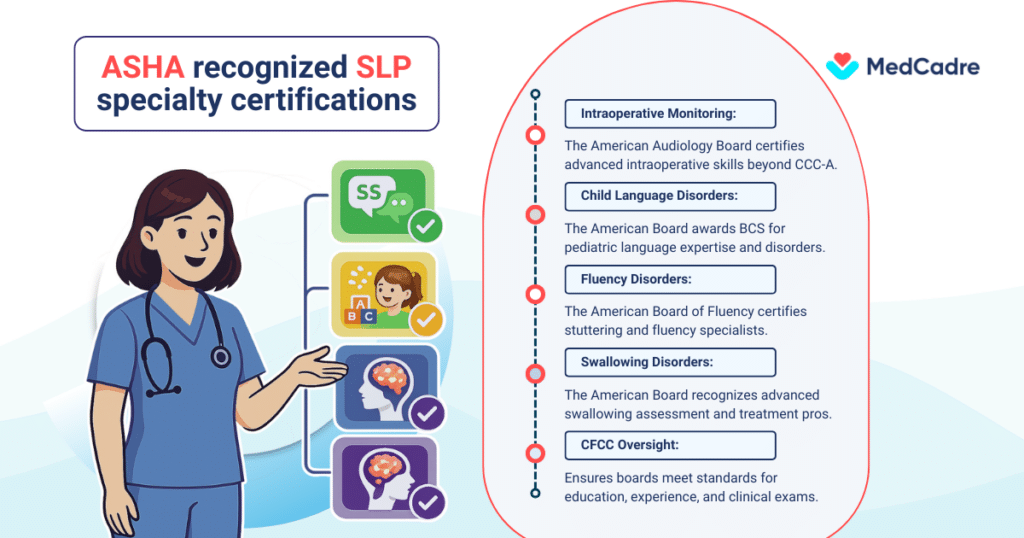
Speech-language pathologists master specialty areas to advance their careers and enhance clinical expertise. A detailed infographic has been added to improve understanding of professional certification pathways.
ASHA recognized SLP specialty certifications
Why speech therapy is a career worth choosing
Pursuing speech therapist jobs offers long-term career stability and professional growth that meet your requirements. As healthcare, educational, and rehabilitation settings continue to expand speech therapy services nationwide, demand for qualified and skilled professionals remains strong.
More healthcare professionals are exploring flexible, location-based job opportunities that align with their clinical interests, preferred care settings, and long-term career plans.
In addition to job security, these speech therapy professions offer competitive earning potential. Speech therapist salaries vary by experience, specialization, and location, but remain attractive compared to many allied healthcare roles.
Beyond financial benefits, speech therapy provides meaningful work by helping individuals improve communication, regain independence, and enhance overall quality of life, making it a career choice with both professional and personal rewards.
As a speech-language therapist exploring new job opportunities, staying informed about current salary trends can help you approach job negotiations with greater confidence. A detailed infographic outlining salary insights is included below to support a better understanding.
Annual wages of speech-language therapists by state

Source: www.bls.gov
Making smarter career moves in speech therapy with MedCadre.
Building a long-term career in speech therapy requires more than completing your education and earning a license. To grow with confidence, you need to stay aware of in-demand skills, current job market trends, and the type of staffing support that can genuinely help you move forward. The choices you make early in your career can shape your earning potential, job satisfaction, and work-life balance.
Many speech-language therapists begin their job search through traditional staffing agencies. While this may feel like a safe option, these agencies often come with limitations, unclear pay structures, slow credentialing processes, and limited visibility into how assignments are matched. Over time, these issues can delay your start dates and make it harder to plan your career with certainty.
This is where a modern healthcare staffing partner like MedCadre makes a difference. MedCadre is built to support clinicians who want clarity, flexibility, and control over their careers.
For professionals comparing opportunities and evaluating speech therapist salary expectations, having transparent information and faster onboarding can be a game-changer. MedCadre offers:
- A transparent pricing model so you clearly understand how much of the billing rate goes to your compensation.
- An AI-driven credentialing platform that shortens onboarding timelines by nearly 30%, helping you start work sooner
- An AI-enabled timesheet system that speeds up approvals and ensures your payments are accurate and on time.
By partnering with MedCadre, speech therapists can spend less time on administrative hurdles and more time on meaningful clinical work. The right staffing partner does not just help you find a job; it also enables you to build a career that aligns with your goals, lifestyle, and long-term growth.
If you are exploring new roles, please check our current openings page to see what opportunities align with your goals. You can also submit your resume if you prefer to be considered directly for upcoming roles that match your skills and career plans.
FAQs
Why are speech therapy jobs in high demand in the USA?
Demand continues to grow due to an aging population, increased awareness of speech and language disorders, early childhood intervention programs, and expanded rehabilitation services for neurological conditions.
What skills are essential for success in speech therapy?
Strong communication skills, patience, empathy, attention to detail, and problem-solving abilities are essential. Speech therapists also need clinical assessment skills and the ability to work collaboratively with patients, families, and care teams.
What should speech therapists consider when planning their career path?
Speech therapists should consider preferred patient populations, work-life balance, location, earning goals, and long-term professional development. Staying informed about industry trends can help guide better career decisions.
How can I find speech therapist jobs near me?
You can find speech therapy job opportunities through MedCadre, which connects professionals like you with roles that match their location preferences, skills, and career goals across multiple care settings.
Is MedCadre suitable for both new and experienced speech therapists?
Yes. MedCadre supports both early-career and experienced speech therapists by offering roles across different specialties, experience levels, and work arrangements.