One important diagnostic resource doctors use is medical imagery, and this is where radiology techs and ultrasound technicians play a vital role in treatment.
Both radiology technologists and ultrasound technicians work in high-technology fields with growing demand and a requirement for specialized training to produce medical images of patients that doctors use for diagnoses and treatment plans.
To pursue a career in any of these fields, you must have an interest in the science of imaging and enjoy working in a field with continual advances in technology. Along with a strong desire to care for patients.
In this blog, you will learn about the differences, educational qualifications, job outlook, and salary between radiology technologists and ultrasound technicians, and what role you can pick as a career.
Differences between radiologists and ultrasound technicians
Radiographers use ionizing radiation to create X-rays that pass through the patient for imaging. These professionals work with X-ray machines and computed tomography (CT) scanners for musculoskeletal imaging.
A radiology technologist performs these responsibilities in many healthcare settings.
On the other hand, sonographers or ultrasound technicians use sound waves for imaging. Based on the Doppler effect, sound waves change. It is like a car horn getting louder as it approaches and fading as it passes.
These changes are interpreted for internal targets as the ultrasound gets closer. This is a key diagnostic method performed by an ultrasound technician in clinical practice.
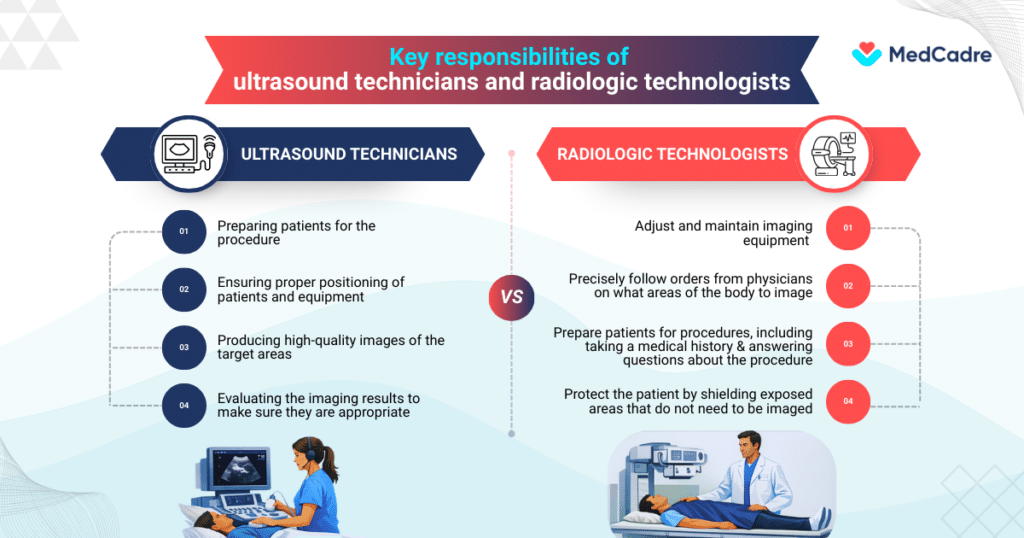
To help you easily compare the responsibilities and technical approaches of both roles. A detailed infographic outlining their core duties is provided below.
Educational requirements
Radiologic technologists in the USA hold at least an associate degree that covers subjects such as anatomy, radiation physics, radiation protection, pathology, and image evaluation.
By earning a Bachelor of Science in Imaging Sciences, radiologic technologists can develop advanced imaging skills and gain a competitive advantage in radiology tech jobs.
To work with equipment that emits radiation, radiologic technologists must be licensed in the state where they work, depending on specific requirements.
Certification from a credentialing organization, such as the American Registry of Radiologic Technologists, is often required.
A bachelor’s degree is generally not mandatory to apply for an ultrasound technician or a radiologic technologist job. Most entry-level positions require an associate’s degree or a certification.
However, completing one can provide advanced knowledge of sonography and additional career opportunities before you apply for an ultrasound technician job.
Most healthcare recruiters look for one or more specialty certifications, such as those offered by the American Registry for Diagnostic Medical Sonography.
In some states, sonographers must also obtain a license to practice. Ultrasound technicians must have strong communication and critical thinking skills to work effectively with doctors and patients during diagnostic procedures.
Job outlook for these roles
Radiologic technologists
Radiologic and MRI technologists are in high demand nationwide. The employment outlook for these roles is expected to rise by 5% from 2024 to 2034.
It is faster than the average for most jobs in the USA, creating steady opportunities for every radiology technologist entering the field. Over the next decade, you can look forward to roughly 15,400 job openings each year on average.
Radiologic technologists and technicians are most employed in California (16,670 jobs), Texas (16,660 jobs), and Florida (14,170 jobs), reflecting large workforce numbers and significant demand in these regions.
Ultrasound technicians
In the USA, demand for diagnostic medical sonographers, or ultrasound technicians, is growing rapidly. According to the Bureau of Labor Statistics, this role is considered to grow by 13% from 2024 to 2034. This growth rate is much stronger than the national average for all occupations.
That means the ultrasound technician job sector is expected to create about 5,800 job openings every year over the next decade.
With steady growth across imaging specialties, many professionals also choose to apply for a radiologic technologist job to expand their opportunities within diagnostic imaging
Many of these job opportunities will come from replacing professionals who transition to other roles or retire, further strengthening career prospects for an ultrasound technician.
How much can you earn in both roles?
As a sonographer, you can earn a good salary. In the USA, the median annual salary is approximately $89,340, making the ultrasound technician salary one of the most competitive among allied health careers.
Experienced professionals can earn more based on high-demand locations, and it also depends on the specialties that you choose to work.
Few hospitals in metro cities like New York may offer above $123,000 per year.
Imaging roles, such as radiologic and MRI technologists, also enjoy competitive wages nationwide.
The median annual wage for these roles is about $77,660 for radiologic technologists, while those specializing in MRI can typically earn a median salary of $88,180, reflecting a strong radiology technologist salary across different specializations.
With experience, certifications, or work in busy healthcare settings, you can reach six-figure salaries as a radiology technologist.
These attractive compensation numbers show that roles like radiologic technologists and ultrasound technicians can offer competitive salaries, along with consistent job growth in the healthcare sector.
As you search and apply for radiology tech jobs or ultrasound roles, understanding the salary expectations upfront can help you make informed career decisions.
Knowing the compensation range allows you to evaluate offers confidently and pursue positions that reflect your skills and experience. For clarity, a detailed infographic is included below to provide a comprehensive overview.
Top-paying states for Ultrasound and Radiologic technologists
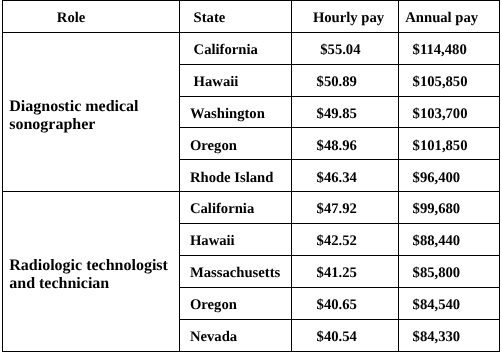
Source: BLS
Secure your ideal job with the right platform
Before choosing between a radiology technologist role and an ultrasound career, take time to evaluate several key factors.
Review the educational requirements. Understand licensing and certification needs. Compare the job outlook. Study salary trends, including ultrasound technician salaries in your preferred location. These factors help you make a confident and informed decision.
Once you decide which path fits your goals, the next step is learning how to land the job. Securing the right opportunity is just as important as choosing the role itself.
Avoid relying only on traditional staffing agencies. They often lack transparency in their pay structures.
The onboarding and credentialing process can also take longer than expected. Free job portals may seem convenient, but they attract high competition and rarely provide personalized support during hiring.
Choosing MedCadre is a smarter option. It uses AI-powered technology, making the platform flexible and easy to navigate.
You can manage your job search at your own pace while continuing your current responsibilities. The transparent pricing model allows you to receive a significant portion of your billable rate.
Credentialing is 30% faster than traditional staffing methods, helping you start sooner. The AI-integrated timesheet ensures accurate approvals and timely payments by reducing administrative delays.
With the right preparation and the right platform, you can move forward with clarity and secure the healthcare career you truly deserve.
To stay ahead in your career, check our current openings page regularly to explore opportunities that align with your preferences. If you do not find an immediate match, you can also submit your resume for upcoming allied jobs. With proper research and the right platform, you can secure a rewarding role that supports long-term career growth.
FAQs
Is certification required to work in these roles?
Yes, certification is often required or strongly preferred by employers. Radiologic technologists typically need certification from the American Registry of Radiologic Technologists (ARRT). Ultrasound professionals often pursue certification through the American Registry for Diagnostic Medical Sonography (ARDMS). Some states also require licensing
Which role offers a higher salary in the USA?
Ultrasound technicians generally earn a higher median salary than radiologic technologists. However, pay depends on experience, certifications, specialization, and location. Metro cities and high-demand specialties usually offer higher compensation
How can I improve my chances of landing a job?
Research salary expectations and job outlook before applying. Obtain the required certifications. Build a strong resume that highlights clinical training and technical skills. Choosing the right hiring platform can also speed up credentialing and placement
How is MedCadre different from traditional staffing agencies?
Unlike traditional agencies, MedCadre offers a transparent pricing model and faster credentialing. You can track your process clearly, without hidden margins or long wait times. The platform is designed to give professionals more control over their careers.
How does MedCadre help me get started faster?
MedCadre, a healthcare staffing platform, delivers credentialing up to 30% faster than traditional staffing agencies. This means you can complete documentation and verification more quickly and begin working at your desired location sooner.