Hospital-based healthcare social workers play a vital role in the facilities. These dedicated professionals possess a unique set of skills that provide crucial support to patients and their families when needed.
With growing compulsion to accelerate discharges and free up more beds, hospital social workers are stretched to capacity.
Ineffective technology and complex systems also leave them with less time to provide individualized emotional and social support.
Social workers like you who work in hospitals have multi-dimensional roles, and you play a vital part in delivering personalized care.
You also ensure that patients receive the right support and guidance while working in structured healthcare social worker jobs across different facilities.
Most importantly, healthcare social workers in facilities act as a bridge. They take a comprehensive approach to a patient’s care, examining health issues within a broader context that considers every aspect of a patient’s life.
By this, you must understand the importance of social workers in a facility. When these professionals are so vital, then it is obvious that they are fully occupied, and because of this, they may have less time for themselves.
This will lead to challenges in their life. In this blog, we will discuss the challenges social workers face.
List of challenges hospital social workers face
Social workers in hospitals will handle many responsibilities in addition to patient care as part of demanding healthcare social worker jobs.
A few times, it includes facility administration if you are a senior team member. As a result, you may frequently encounter difficulties with the volume of work, communication coordination, and role mismanagement while working as a hospital social worker.
Knowing about these challenges helps professionals manage and safeguard their stress levels. The challenges are detailly mentioned below.
Ineffective communication and coordination
Communication and cooperation among teams and patients are important for successful discharge work by healthcare social workers.
However, keeping everyone informed, involved, and aligned toward the same goals is often difficult.
To overcome this challenge, it is essential to address ineffective communication and collaboration within the team.
The following are some of the communication barriers you face while working as a social worker:
- Lack of systematized communication protocols
- Limited access to team meetings
- Difficulty in accessing patient information
- Limited opportunities to work with different teams
Expecting and avoiding burnouts
Experienced social workers may face unexpected surges in workload within settings. This often requires managing multiple patients simultaneously, especially in facilities with limited staffing resources.
In addition to patient responsibilities, social workers may also spend significant time on administrative duties such as documentation and team coordination.
These tasks may become even more time-consuming when facilities rely on outdated technology. This may force you to spend extra time on routine processes.
This extra time may lead to overtime, limited patient satisfaction, and postponed personal responsibilities. This pressure may lead to physical and emotional exhaustion.
Another important factor you must watch for is compensation. Not offering market-trending salary is also a warning sign, as poor pay combined with heavy workload often increases burnout over time.
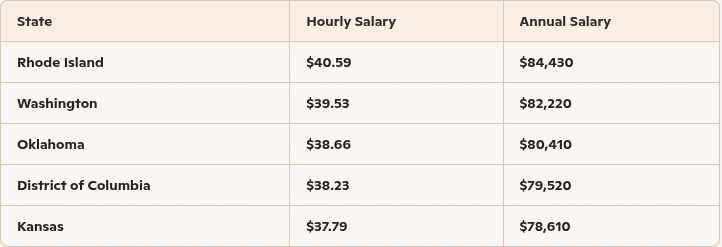
To stay updated and make informed career decisions, you must be aware of current salary trends. A detailed infographic is added below for better understanding.
Top-paying states for Social Workers in the USA
Source: www.bls.gov
As a working professional, you must understand that these challenges are to prevent burnout and maintain long-term professional development as a healthcare social worker.
Missing work-life balance
The demanding nature of social work often affects your personal life. Long working hours and responsibilities can make it difficult for you to maintain a work-life balance, especially for healthcare social workers working in acute care settings.
To address the imbalance between work and personal time, professionals need to create separate schedules for each. The following are the points to maintain a balanced work-life.
- You must set hours and limit after-hours work activities, such as answering work emails.
- Must not forget to take regular vacations to relax.
- Continue to pursue hobbies and activities outside your work life.
- Do not let your professional stress affect your personal life.
Challenges in continuous learning
Social workers may struggle to find time for continuous learning while managing daily responsibilities. This is often due to heavy workloads and limited opportunities to attend training or update market-required skills.
Many facilities do not actively support ongoing education. As a result, professionals may feel stuck in the same roles and miss opportunities for professional growth.
You must maintain exercises that help you cherish both your professional and personal life. It will help you to sustain your passion for doing good.
Lack of role clarity
While you are looking for a social worker job, it is important to understand the role in detail through the job description.
There may be more instances when you overlook responsibilities, which can affect long-term healthcare social workers’ salary expectations.
This oversight means that social workers like you often feel pressured to relinquish your power and hand decision-making over to the medical team.
This can leave you feeling demotivated and can weaken your sense of professional identity.
It also slows progress toward building a truly integrated and supportive health and care system.
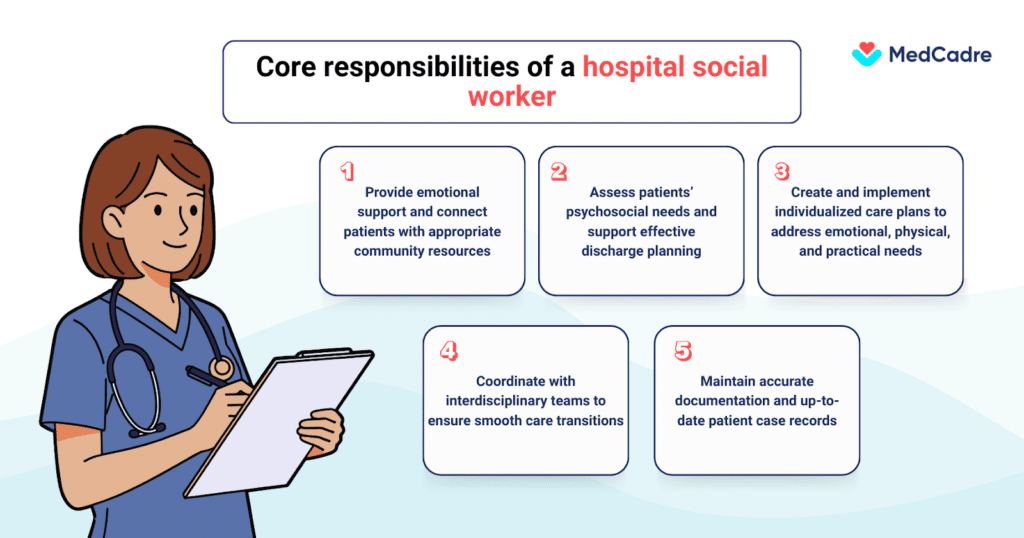
As an experienced professional, carefully reviewing the job description before you apply for a social worker job helps you avoid role clarity issues. A detailed infographic is included for better understanding.
Choosing the right workplace matters to overcome work-life challenges
Learning about the challenges discussed above can help you continue your work as a healthcare social worker with greater calm and confidence.
Awareness helps you prepare better and handle daily responsibilities with less stress.
Before joining any facility, it is your primary duty to research the facility and its work culture.
When the facility and team are supportive, most of your work-life challenges become easier to manage. Supportive leadership and clear communication will reduce pressure on your workload and improve job satisfaction.
You must take responsibility for researching the facilities that truly support professionals like you. While researching opportunities, avoid relying on traditional agencies or free job portals.
Free job portals may often provide limited role clarity and outdated listings. Traditional agencies also lack transparency and delay your placements due to manual processes.
To overcome these challenges, you should choose a modern staffing platform like MedCadre.
This modern staffing process focuses on professional growth, transparency, and efficiency. It supports professionals with technology-driven solutions that simplify the job search and onboarding process.
Benefits of leveraging MedCadre to find your next Social Worker job:
MedCadre’s flexible application process allows you to manage your job search at your own pace.
Its transparent pricing structure ensures fair compensation without hidden deductions.
The AI-driven platform speeds up credentialing by nearly 30%, reducing delays.
The AI-integrated timesheet enables faster approvals and accurate, on-time payments.
Choosing the right platform and workplace helps healthcare social workers build a stable, fulfilling, and stress-free professional journey.
If you are a working professional looking to explore new roles, please check our current openings page to see what opportunities align with your goals.
You can also submit your resume if you prefer to be considered directly for upcoming roles that match your skills and career plans.
FAQs
Why do healthcare social workers experience burnout?
Burnout often happens due to heavy workloads, emotional pressure, and time constraints. Managing multiple patients while handling administrative work adds stress and overtime in shifts. This affects both mental and physical well-being.
How can healthcare social workers reduce work-related stress?
Setting clear boundaries between work and personal time helps. Taking breaks, using leave time, and asking for support when needed are important. Choosing a supportive workplace also makes a big difference. Self-care is not optional; it is essential.
What challenges do hospital social workers face daily?
Common challenges include high caseloads, unclear job roles, and communication gaps within teams. Administrative work often takes time away from patient interaction. Emotional situations can also be difficult to manage. These challenges can build up over time.
Why should I choose MedCadre over free job portals?
Free job portals often show outdated or unclear listings. MedCadre provides detailed job details and active openings. This saves you time and avoids confusion during the application process. You can apply with confidence, knowing what to expect.
Can MedCadre help me find healthcare social worker jobs near my location?
Yes. MedCadre helps you explore jobs near your preferred location by matching your profile with facilities and your location needs. This reduces long commutes and helps you maintain a better work-life balance.