With the help of modern technology, the healthcare sector continues to grow rapidly. This growth is opening the door to many rewarding careers for people interested in patient care.
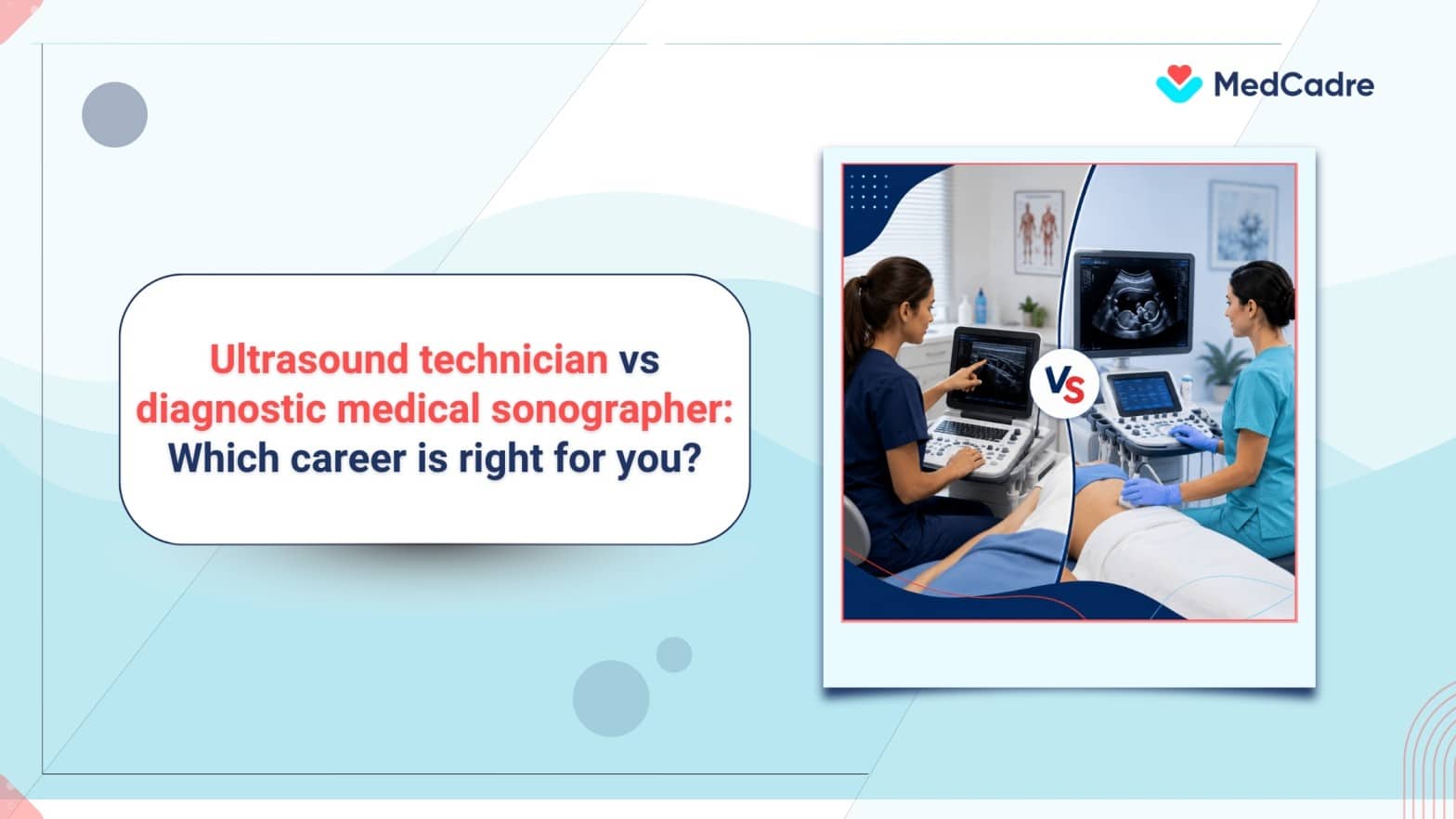
If you are looking for careers in medical imaging, you might have come across ultrasound technician and diagnostic medical sonographer roles.
As a job seeker, when you compare a sonographer vs. an ultrasound tech, both these healthcare roles may seem very similar. But they have different daily duties, require different education, and require different skills.
Because of different skills and responsibilities, you will have different salaries and career growth opportunities.
This blog explains the difference between sonographers and ultrasound techs and the skills, salary, and qualifications needed, helping you understand the differences and choose the role that fits your career.
Understanding the difference between an ultrasound technician and a diagnostic medical sonographer
If you are a recent graduate or planning a transition, it is important for you to understand how roles differ from each other.
If you are planning to apply for an ultrasound technician job, comparing it with a diagnostic medical sonographer, knowing the difference between a sonographer and an ultrasound tech may help you to choose a better role.
As a job seeker, remember that both professionals use ultrasound technology and work with patients. So, learning about these essential differences can help you choose a role that fits your career goals.
What does an ultrasound technician do?
Choosing to work as an ultrasound technician is a better option because these professionals use ultrasound equipment to create images of organs and other parts of the body. These high-quality images are used by physicians to examine patients and provide treatment.
If you are an individual who prefers interacting with patients by using medical equipment, then you should apply for ultrasound technician jobs, as they are a great fit for your interests.
What does a diagnostic medical sonographer do?
Few healthcare professionals prefer working with medical imaging and want to work closely with patients to treat them
The day-to-day responsibilities of diagnostic medical sonographer jobs include performing ultrasound exams on patients using specialized medical imaging equipment to take images of organs and tissues of the body.
These medical images help physicians examine patients and identify or monitor health conditions. Healthcare professionals can choose a diagnostic medical sonographer career as it combines patient care and medical imaging technology in the diagnostic process.
Comparing education requirements for ultrasound technician vs. diagnostic medical sonographer
Once you know the difference between a sonographer and an ultrasound tech, you must prepare yourself to choose a role that fits your career.
Before choosing a role that fits your career as a job seeker, you must know and understand the educational requirements.
To understand easily, it will be better to compare formal educational requirements for sonographers vs ultrasound techs.
This process will tell you that to apply as an ultrasound technician, you need to complete a certificate or associate degree program in sonography.
This certification covers patient care, the use of ultrasound equipment, and imaging techniques that you need to practise in your professional career.
On the other hand, you can apply for diagnostic medical sonographer jobs if you have completed an accredited sonography program, often at the associate degree level.
This essential program includes your classroom learning and clinical training to prepare patients for diagnostic ultrasound exams.
Having clear knowledge about educational qualifications will help you craft a CV that helps recruiters hire you in quick time.
Essential skills you need for each role
Once you have gathered information about educational requirements that give you a clear understanding of the difference between a sonographer and an ultrasound tech, you must also research essential skills.
Researching skills is vital because, along with education, skills will help you advance your career in the competitive healthcare world.
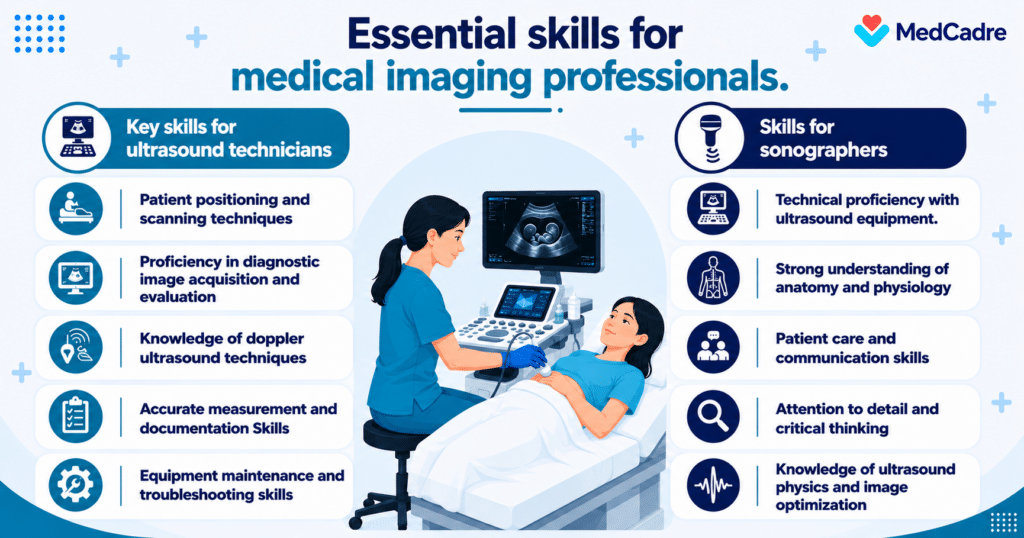
So, before choosing a role, you must cross-check if you have knowledge related to the skills, as both these roles want you to have good communication, attention to detail, and the ability to work with ultrasound equipment.
For example, if you want to choose an ultrasound technician career, remember that you may focus more on patient interaction and performing routine imaging tasks.
If you are planning to apply for a diagnostic medical sonographer job, you may need skills such as image optimization.
Along with this, you may also need to identify normal and abnormal findings in images and create accurate documentation. Having strong attention to detail will also be an added advantage.
Before applying for or choosing a job role, knowing these skills can help you understand
what each role involves. This understanding also helps you decide which role matches your professional growth.
Employer-preferred skills for ultrasound technicians and medical sonographers
Key certifications for ultrasound technicians and diagnostic medical sonographers
Most healthcare recruiters are choosing professionals with certifications to enhance their patient care. Through this, you may have understood the importance of having certifications in your professional life.
So, as a job seeker, you must understand that after completing your education, you must also have certifications to be a standout applicant during the job search process.
For example, if you are planning to apply for an ultrasound technician job in California, you must have a valid license and certifications such as the Registered Diagnostic Medical Sonographer (RDMS) certification through ARDMS.
Having certifications may help you show your knowledge and technical skills.
In the same way, if you are planning for a sonography career, you must have a certificate such as Registered Diagnostic Medical Sonographer (RDMS) in a specialty, which helps your career goals.
Since certification and licensing rules may differ from one state to another and from one recruiter to another, you must carefully check the requirements for the role in the job description before applying.
Salary comparison for ultrasound technicians and diagnostic medical sonographers
Along with education, skills, and certificates, one of the most vital things to look after before you apply for a job is salary.
It is vital because having a competitive salary affects your financial goals and career plans. As a job seeker, you must understand that both ultrasound technicians and diagnostic medical sonographers use technical skills in their work to treat patients.
Even though they work with medical imaging, their salaries may vary based on experience, certifications, specialty, and location.
For example, if you are planning to apply for a diagnostic medical sonographer job in New York, you can earn an average annual salary of $94,180, with an average hourly wage of $45.28.
So, before you apply for a medical imaging role, it is essential for you to stay aware of the current salary numbers so that you can choose a better offer, and if needed, it also helps you to negotiate with recruiters.
A table about salaries that compares sonographer vs ultrasound tech salaries is added to give you a clearer idea of what you may earn in each role.
Sonographer vs. Ultrasound technician salary comparison by state
Role | State | Hourly pay details | Annual pay details |
Ultrasound Technician | California | $56–$79/hr | $116,000–$164,000/yr |
Illinois | $37–$61/hr | $77,000–$127,000/yr | |
New York | $44–$58/hr | $91,000–$120,000/yr | |
Texas | $34–$48/hr | $70,000–$100,000/yr | |
Georgia | $33–$46/hr | $68,000–$96,000/yr | |
Sonographer | California | Up to $65/hr | $135,457/yr |
New York | $59–$60/hr | $122,720–$124,800/yr | |
Oregon | $54–$55/hr | $112,320–$114,400/yr | |
Illinois | $58/hr | $120,640/yr | |
Texas | $42–$43/hr | $87,360–$89,440/yr |
Source: Glassdoor
Find your next medical imaging role with the right staffing platform
After knowing vital details such as educational requirements, skills, certifications, and salary, one more essential thing to know is how to land a desired job as early as possible.
To land your desired job, the next step is finding the right healthcare staffing platform. You must choose a platform that helps you find positions that fit your qualifications and location.
In this process, you need to reduce your dependence on traditional agencies because these agencies will make you deal with lengthy manual processes. Along with this, they also come with unverified job postings.
To overcome these hurdles, you can use a platform like MedCadre. This platform allows you to connect with verified hospital managers and explore suitable openings.
By choosing MedCadre, you will get benefits such as:
- Detailed compensation information before accepting an assignment.
- Submission of timesheets through an organized process.
- Complete credentialing up to 30% faster.
You can check the current openings page to see available positions. You can also submit your resume to be contacted about future opportunities that match your career goals.
FAQs
Do ultrasound technicians and sonographers need certification?
Certification requirements depend on the employer and state. Many employers prefer professional credentials such as the Registered Diagnostic Medical Sonographer (RDMS) certification through ARDMS. Always check the requirements for the specific job before applying.
What can influence the pay of a diagnostic medical sonographer?
A diagnostic medical sonographer’s salary may differ based on your professional experience, area of specialization, certifications, work location, and employer. Pay can also vary considerably between different states and healthcare facilities.
What factors affect an ultrasound technician’s pay?
Your ultrasound technician salary can depend on your experience, location, specialty, certifications, and employer. The salary figures in the blog also show that pay can vary considerably between states.
Does MedCadre offer full-time and contract healthcare jobs?
Yes. MedCadre offers both full-time and contract positions. The company also provides travel and locum tenens opportunities, so you can choose a work arrangement that fits your career plans.
What types of healthcare facilities does MedCadre work with?
MedCadre provides staffing services to hospitals, private clinics, pharmacies, and diagnostic centers. This gives job seekers access to opportunities across different healthcare settings.