
The U.S. healthcare sector is constantly changing and offers a wide range of career opportunities.
Whether you are starting your career or looking for a job change, you can find roles that offer career growth and competitive salaries.
This blog explains the most in-demand healthcare jobs with salary expectations.
Along with this, you will also learn about the responsibilities and the qualifications needed to get started, whether you are a fresher or an experienced professional.
Why are healthcare jobs in demand
Choosing to work in the healthcare sector is a well-planned decision. So, for those individuals or professionals who is looking to apply for a healthcare job or planning for a transition must know few important factors.
One such factor is knowing why healthcare jobs are in demand.
As a job seeker, you need to know that the demand is driven by multiple factors.
Those include an aging population, the growth of new facilities, and affordability in health insurance.
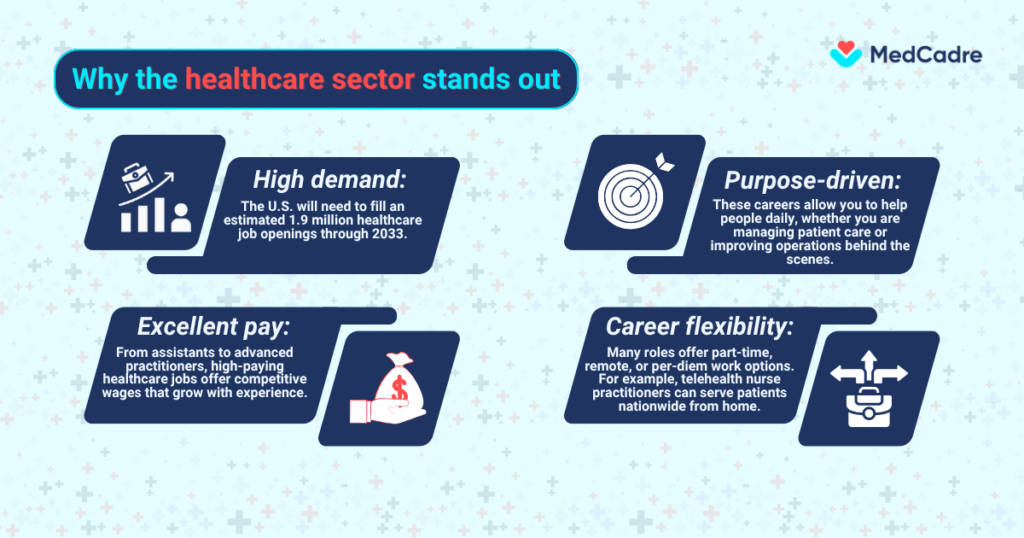
Along with this, new technologies are also opening more diverse career paths for professionals. A detailed infographic is added below, highlighting why healthcare jobs are in strong demand.
Key factors behind healthcare job growth and demand
Most in-demand healthcare jobs in the USA
While applying for healthcare jobs as a job seeker, you need to know about the most in-demand roles.
Having knowledge about these roles will help you make planned decisions.
Below is the list of in-demand medical jobs that offer strong career progression and competitive salaries.
#1: Nurse Practitioner (NP)
Job seekers can choose and apply for nurse practitioner jobs, as they play vital roles in diagnosing and treating illnesses.
They also prescribe medications and manage patient care independently or alongside physicians.
To qualify for this role, you need a master’s or doctorate in nursing, an RN license, and NP certification.
This career also offers opportunities to specialize in areas such as family care, pediatrics, and acute care, along with greater autonomy in patient care.
With rising rates of chronic illness, nurse practitioners (NPs) are increasingly important in providing advanced care, especially in underserved areas. The average annual salary ranges from approximately $100,000 to $200,000.
#2: Physician Assistant (PA)
The growing need for cost-effective, quality healthcare brings demand for skilled physician assistants. With the right qualifications and clinical training, you can apply for a physician assistant (PA) role and step into a field with strong and growing opportunities.
In this role, you will perform physical exams, order tests, diagnose illnesses, and assist in surgeries under physician supervision.
To work in these roles, you need to have a master’s degree from an accredited PA program and national certification.
By working as a physician assistant, you can earn from $1L to $2L per year.
#3: Certified Registered Nurse Anesthetist (CRNA)
Skilled CRNAs provide essential anesthesia services in clinics and hospitals.
Many qualified professionals apply for certified registered nurse anesthetist (CRNA) roles to take on crucial responsibilities with surgeons in operating rooms.
While working as a registered nurse anesthetist, you need to administer anesthesia, monitor patients during surgeries, and ensure pain management.
Having a Master’s or Doctorate in Nurse Anesthesia, an RN license, and CRNA certification will allow you to work in these roles.
These healthcare roles are among the top-paid nursing roles, so you can earn $132,507 per year.
#4: Physical Therapist (PT)
An aging population and rehabilitation requirements drive demand for physical therapist jobs. If you are planning to apply for physical therapist (PT) roles, you must know that you will directly support patients in regaining strength, movement, and independence.
Having a Doctor of Physical Therapy (DPT) and required state licensure can help you earn $101,020 per year in the USA.
#5: Occupational Therapy Assistant (OTA)
The need for rehabilitation and support in daily living activities, especially among the elderly and disabled, is growing. Because of this demand, many professionals apply for occupational therapy assistant (OTA) roles for career growth.
These roles work closely with patients and support their independence in everyday life.
Key responsibilities of this role include assisting occupational therapists in helping patients regain health through therapeutic techniques.
An Associate’s degree from an accredited OTA program will bring you opportunities in schools, rehab centers, and mental health facilities. As an occupational therapist with in-demand skills, you can earn $98,340 per year.
What it takes to transition to new roles in healthcare
Transitioning to a new role in the healthcare sector is more feasible than ever for those already working in the field. Many positions offer clear paths for advancement or lateral moves, with varying levels of additional training or certification.
Whether you are upgrading your skills or pursuing a new specialty, exploring the healthcare careers list published by recruiting platforms can help you understand the range of roles available and choose the right path.
Flexible education options also cater to professionals at all levels.
As an experienced working professional considering a move to a new state for your next healthcare role, you can follow useful relocation tips, such as confirming state licensing and renewal requirements, attending mandatory onboarding training for your new role, and more.
Education paths:
- Medical Assistants: If you are already in healthcare, a short training program at a community college or trade school (typically 1-2 years) can equip you for a role as a medical assistant.
- Nurse Practitioners: Registered nurses who are looking for career advancement can pursue a master’s degree, complete 500–700 clinical hours, and obtain board certification to become nurse practitioners
Quick-start roles:
- Respiratory Therapists and Diagnostic Sonographers: With your existing healthcare background, you can fast-track through associate degree programs and internships (typically 2–3 years) to transition into these roles.
Skills in demand:
- Soft Skills: As a healthcare professional, you likely already have strong communication and teamwork skills, but refining your compassion and adaptability will always make you stand out.
- Technical Proficiency: Being fluent in electronic health records (EHR) systems and mobile health technologies is crucial to advancing in today’s healthcare landscape.
Certifications:
If you are moving into a new role, certain certifications will increase your credibility and job prospects. Common certifications include:
- PANCE (for Physician Assistants),
- NCLEX-RN (for Registered Nurses),
- ARDMS (for Diagnostic Sonographers).
These certifications are essential to securing many of the higher-paying jobs in healthcare.
Advancing your healthcare career as an experienced professional
If you are an experienced professional and looking for the next step in your career? You can explore healthcare jobs that offer career growth and better earning potential.
Developing new skills or moving into specialized areas can also help you expand your expertise. This also helps you pursue roles that align with your career.
Here are some key benefits of advancing your healthcare career:
- Leadership opportunities: Experience can lead to advancement into roles like healthcare manager, surgical team lead, or clinical director, many of which offer six-figure salaries and high authority.
- Professional Fulfillment: Long-term caregivers, therapists, and nurses report deep emotional rewards from sustained patient relationships and the sense of making a lasting difference.
- Career stability: Even during recessions or tech disruptions, healthcare jobs in demand remain secure. People always need care, making this field reliably future-proof.
- Growing healthcare careers: Experienced professionals also have more mobility across state lines and specialties, thanks to license compacts and telehealth platforms.
Healthcare careers continue to experience strong and steady growth, providing professionals with clear career progression and stability.
Whether you are advancing in leadership or exploring specialized roles, the opportunities for long-term professional growth are abundant.
With the healthcare industry, especially the nursing sector, continuing to thrive, you can also read about the future of travel nursing: trends you need to know, as it provides valuable insights into the evolving opportunities within travel nursing.
How to get started in healthcare jobs as a fresher
Have you completed your healthcare-related education and are you looking for a job?
As a job seeker, you need to know that there are several opportunities to begin your professional career in the healthcare industry.
While some roles require specific medical qualifications, many other positions allow you to contribute to patient care without a medical degree. But to join these jobs, you need to have some strong foundational skills.
Here is how to build your foundation:
- Network early: Join associations like the American Nurses Association, attend hospital-hosted hiring events, and follow healthcare career forums. It is a great way to gain mentors and access job leads.
- Smart job search: Use platforms like MedCadre and hospital websites, as these platforms are tailored to connect you with the highest-paying jobs in the medical field.
- Skill up: Start with basic certifications like CPR, HIPAA, or electronic health record systems. These build credibility and can set you apart for entry-level jobs in demand.
Take time to explore these resources, build your network, and gain the essential skills that will serve as the foundation for a rewarding healthcare career.
With the right preparation and determination, the opportunities are abundant for those ready to take the first step. If you are a new graduate knowing about job outlook about the most in demand helps you choose a more suitable role. To help you, a table with jobs and their growth percentage is added.
Demand trends for healthcare roles
Job title | Growth outlook | Professional advantages |
Nurse Practitioner | +40% | Advanced patient care, high autonomy |
Physician Assistant | +28% | Flexible specialty options, strong demand |
CRNA (Nurse Anesthetist) | +40% | One of the highest-paying jobs in the medical field |
Physical Therapist | +14% | Direct patient recovery work, varied settings |
Occupational Therapist (Assistant) | +11% | Support independence in daily life |
Source: www.bls.gov
How to find the right healthcare jobs with a staffing platform
Whether you are an experienced professional or a new graduate who is starting your career, finding the right job is an important step. This step helps you grow your career over the long term.
If you are looking to advance your career with high compensation, partnering with a staffing platform can make the process easier.
While choosing the right platform, you can try to avoid partnering with
traditional staffing agencies. It is an advised strategy to avoid these, as they may come with multiple challenges.
The challenges include poor communication, unverified job postings, and lengthy credentialing.
These agencies also come with limited pay transparency. These challenges can delay your job search, even when you have the right qualifications.
To overcome these challenges, you can partner with MedCadre. It is an AI-powered staffing platform that simplifies the job search process.
MedCadre also comes with multiple benefits, such as faster credentialing, verified job postings, and transparent compensation details. These benefits make your job search process easier.
Healthcare professionals like you can search current job openings and apply for roles that match their qualifications.
You can also submit your resume to receive updates about new opportunities that align with your career goals.
FAQs
Are healthcare jobs a good choice for long-term career growth?
Yes, healthcare offers strong opportunities for long-term career growth and stability. You can advance into specialized clinical roles, leadership positions, or new healthcare specialties by gaining experience and upgrading your skills.
Can I start a healthcare career without a medical degree?
Yes, you can explore healthcare careers without a medical degree. Roles such as Medical Assistant, Patient Care Technician, and healthcare administrative support offer opportunities with relevant training, diplomas, or certifications.
What qualifications do I need to apply for healthcare jobs?
Healthcare job qualifications vary by role. Some positions require an associate degree or diploma, while advanced clinical roles need specialized degrees, state licenses, and professional certifications.
Can I find high-paying healthcare jobs through MedCadre?
Yes, MedCadre connects qualified professionals with healthcare opportunities offering competitive compensation. You can explore available positions, compare pay details, and choose opportunities that match your qualifications and salary expectations.
Does MedCadre help with healthcare job credentialing and onboarding?
Yes, MedCadre supports healthcare professionals throughout the credentialing and onboarding process. Its recruitment team helps with license verification, documentation, and other requirements to make the transition into a new role easier.