
The demand for temporary job seekers has recently increased, especially in healthcare. These roles are in demand because they offer many opportunities for people seeking flexibility and variety in their work.
As a job seeker you need to understand working in temporary allow you to work in various settings while gaining valuable skills through exposure.
To succeed in these temporary healthcare roles, you need strategies to show adaptability, clear communication, and professionalism.
By following a few key principles, temporary employment can lead to career advancement with well-paid salaries.
This blog explains some useful tips to help you succeed in temporary healthcare positions and make the most of your work experience.
Flexibility within temporary healthcare positions
Flexibility can be a crucial aspect for practitioners working in healthcare contract jobs. Many job seekers prefer temporary roles because they offer opportunities to work with different patient populations. It helps you gain experience in various healthcare settings.
Along with gaining experience, it allows you to stay flexible. This flexibility helps you maintain work-life balance, and this is the main reason many professionals choose temporary roles.
This is especially true for roles such as medical assistants and pharmacy technicians, who often need to switch between varied responsibilities.
To adapt easily to temporary healthcare positions, you can follow the points below:
- Learn new systems and workflows at each workplace.
- Take on additional responsibilities when needed.
- Adjust to changing work schedules and team dynamics.
By staying open to new experiences, you can make each temporary assignment a valuable learning opportunity.
Communication is key to temporary healthcare employment success.
Communication is essential in temporary healthcare staffing environments. You will usually be dealing with half a dozen new teams and half a dozen new supervisors. It is best to introduce yourself early and establish open lines of communication.
Learning effective communication through essential healthcare certifications will prevent misunderstandings, build trust, and facilitate excellent patient care going forward.
For instance, medical assistants explaining procedures to patients, pharmacy technicians coordinating with nurses, and allied health assistants supporting therapy sessions all rely heavily on clear communication to succeed in temporary roles.
Do your best to ask for clarification if necessary, as this demonstrates your commitment to doing things correctly.
Keeping managers updated on your progress will also give you a good impression and provide more options down the road.
Professionals working in contractual healthcare jobs who demonstrate strong communication skills are more likely to be considered for future opportunities.
To communicate effectively in temporary roles, you can follow these steps:
- Quickly introduce yourself to colleagues and supervisors.
- Keep communication open and professional.
- Provide updates on client expectations.
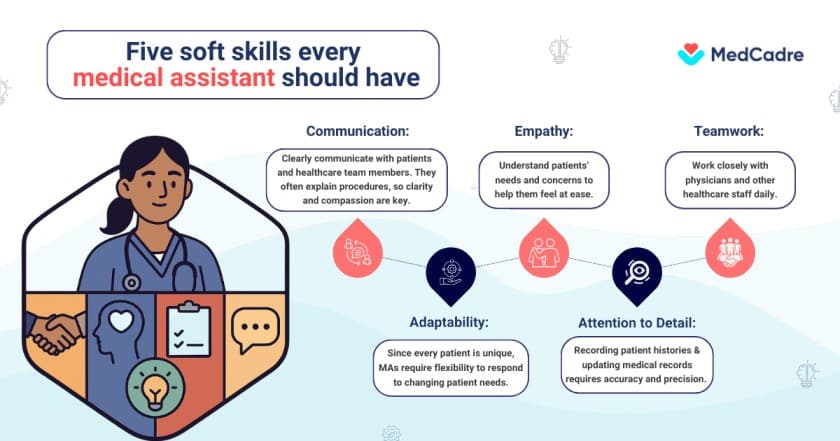
Along with strong communication abilities, soft skills are also vital in temporary healthcare roles, as they help professionals adapt quickly and work effectively in new environments.
To provide a clearer picture, the top skills are listed below for better understanding.
Must-have soft skills for medical assistants
You need to be a team player in healthcare opportunities.
When you start a locum healthcare job, being a team player is key to blending in quickly with the existing team and building strong, collaborative relationships.
To be a successful temporary worker, being a team player is essential, as it enables you to quickly understand the collaborative climate and gain acceptance from your team.
By offering assistance to complete patient responsibilities, sharing your experience, and promoting collaboration among your new colleagues, you are sure to stand out from other temporary staff regardless of your skill level.
Working as a team is the best way to enhance patient care as well as your own experience in a locum healthcare job.
Supervisors often highlight individuals in healthcare jobs on a contract basis who demonstrate teamwork, reliability, and resourcefulness as ideal candidates for repeat assignments.
To contribute to a positive team environment, you can follow these practices:
- Learn the routines of the team and consistently follow them
- Share your knowledge and skills when appropriate
- Show excitement about collaborating and being a team player
Being professional with other employees helps you improve patient care and create opportunities for future assignments.
Maintain professionalism in temporary healthcare roles
Starting a new healthcare assignment may give you different feelings because of different teams. You may also take time to adjust to new environments.
That is why, as a working professional, you need to maintain professionalism. Being punctual and treating colleagues and patients with respect are essential.
These small habits help build trust, especially when you are new to a workplace. Over time, a professional and consistent attitude can help transform your temporary roles into long-term opportunities.
Here are a few simple practices to follow:
- Always arrive on time for shifts and meetings
- Dress appropriately according to workplace standards
- Treat patients and colleagues with respect at all times
These habits help you maintain professionalism and create a positive workplace environment.
Seek continuous learning for career growth
Maintaining a habit of continuous learning through certifications will help you gain new skills.
Having essential certifications and skills will add weight to your resume while you are applying for temporary roles.
Most healthcare professionals prefer working in temporary roles as these give you opportunities to grow.
These roles also allow you to take on new responsibilities and enable you to develop experience in various skill sets.
Actively pursuing a continuous learning habit not only strengthens your current performance but also helps you secure better salaries.
The following are the benefits of continuous learning:
- Take on responsibilities that broaden your skills
- Stay updated on new practices and standards in healthcare
- Use each assignment as a stepping stone in your long-term career path.
For example, if you are planning to apply for medical assistant roles on a contract basis, you will get an average hourly salary of $21.25 per hour. Having information about compensation is essential as it helps you choose better roles. It also helps you negotiate your salary while signing the offer letter.
For better understanding, an infographic is provided that highlights details related to medical assistant salaries.
Top-paying states for medical assistants in the USA
State | Hourly pay | Annual pay |
Washington | $25.86 | $53,780 |
Alaska | $25.25 | $52,530 |
California | $24.47 | $50,900 |
District of Columbia | $24.09 | $50,110 |
Minnesota | $23.91 | $49,740 |
Source: www.bls.gov
Finding the right path in a competitive healthcare job market
To find well-paid jobs in this competitive market as a healthcare professional, you must constantly enhance your skills.
Having skills helps you secure better roles that align with your career goals.
Once you gain the required skills, you need to choose a staffing partner to explore new opportunities.
However, most job seekers are choosing traditional staffing agencies to secure a job offer. But these agencies may come with challenges that can delay your process.
The challenges can be:
- Limited access to a variety of healthcare facilities and openings
- Slow hiring processes because of manual work processes
- Limited transparency with salaries
To overcome these challenges, you can choose modern healthcare staffing platforms, such as MedCadre. Unlike traditional agencies, this platform focuses on transparency and accuracy.
MedCadre also comes with multiple benefits such as:
- Transparent pricing model: A significant portion of the bill rate is allocated directly to your pay, providing a clear understanding of your earnings.
- AI-driven portal: This platform speeds up the credentialing process by 30%, allowing you to start your new assignment on time.
- An integrated timesheet: Technology-enabled timesheets ensure timely approvals, enabling you to receive your payments accurately and on schedule.
These benefits help your job search process be more stress-free. As a working professional, you can regularly check current job openings to stay informed about new opportunities. You can also submit your resume to receive information on roles that match your experience.
FAQs
1. How do contract healthcare jobs differ from permanent positions?
Contract healthcare jobs offer temporary assignments lasting from a few weeks to several months. Permanent positions provide long-term employment and consistent benefits. Contract roles offer more flexibility, while permanent positions provide greater employment stability.
2. Why should you consider contract healthcare jobs?
Consider contract jobs if you want more flexibility and career variety. These roles let you explore different healthcare settings, work with diverse patient populations, and develop new skills. They can also offer competitive pay and future permanent opportunities.
3. How do healthcare contract jobs benefit job seekers?
Contract healthcare jobs help you gain experience across different facilities and healthcare settings. You can develop new skills, explore travel opportunities, and access competitive pay. Some assignments may also lead to permanent positions.
4. Can I find contractual healthcare jobs near me through MedCadre?
Yes. MedCadre lists local and nationwide opportunities. You can explore openings based on your location, specialty, and contract preferences. This helps you find roles that match your career goals.
5. How does MedCadre help me balance my current job with my search?
MedCadre offers a streamlined application process. You can explore openings, upload your resume, and apply for suitable positions at your convenience. This helps you manage your job search alongside your current work commitments.