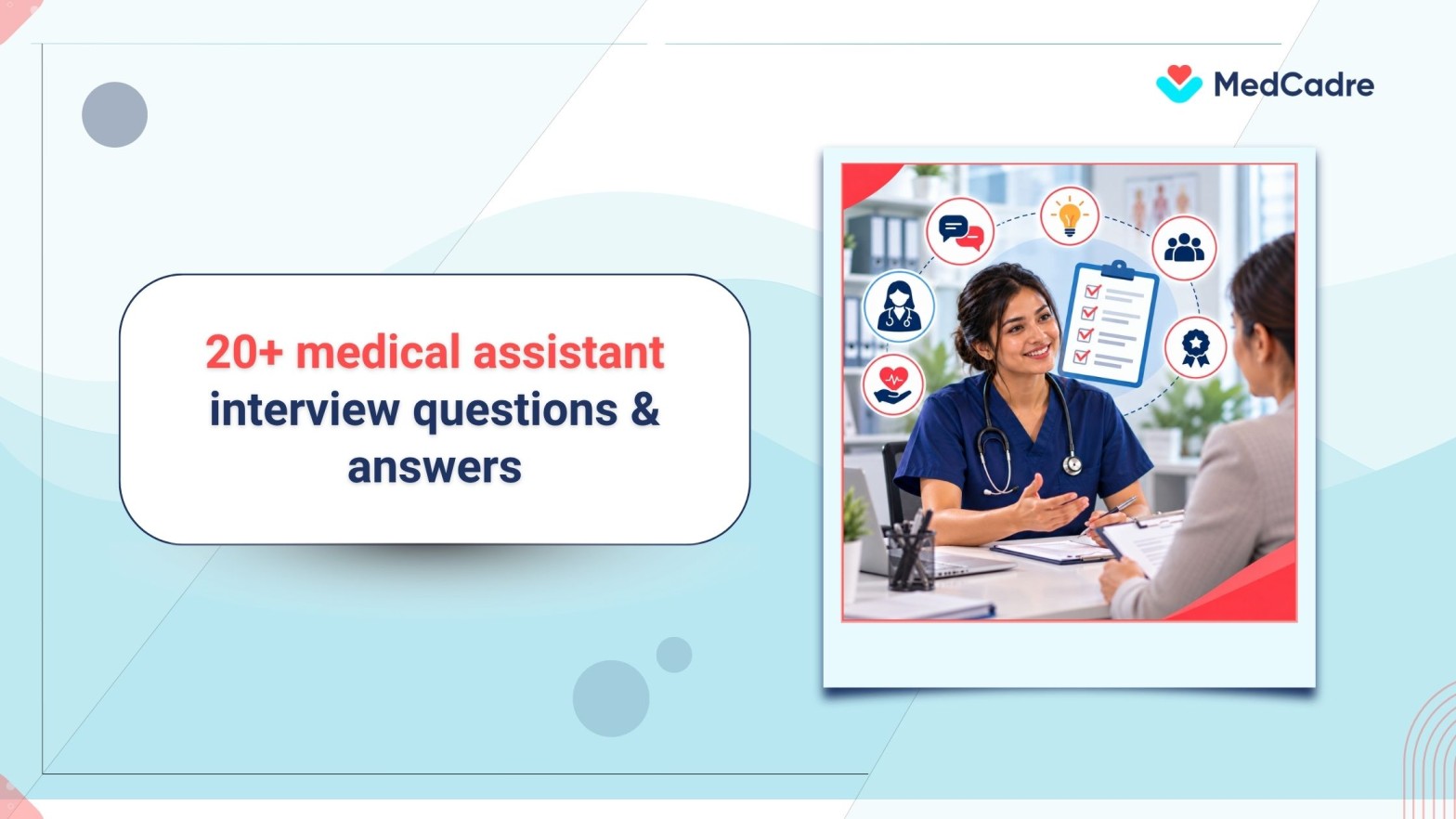
Medical assistant jobs are an essential part of the healthcare team. These roles will be responsible for smoothly integrating clinical knowledge with administrative accuracy to aid patients and providers.
If you are a healthcare professional working as a medical assistant who is looking for a job change, you need a unique blend of technical skills, patient care expertise, and organizational efficiency, making your interview preparation crucial to securing a job that meets your needs.
A well-prepared interview with researched medical assistant interview questions must highlight your qualifications and experience and demonstrate your ability to handle real-world challenges in a fast-paced medical environment.
Employers look for candidates who can think on their feet, communicate effectively, and uphold high standards of patient care. By preparing thoughtful responses, you can showcase your ability to adapt, solve problems, and contribute meaningfully to a healthcare team, benefiting your medical assistant career in the long run.
This blog provides a comprehensive overview of medical assistant interview questions and expertly crafted answers to help you showcase your expertise confidently.
Let us explore some essential medical assistant job interview questions you may face and learn how to answer them effectively.

General interview questions
As a healthcare professional, you must understand that employers often begin with broad questions to understand your background and motivation. The following interview questions focus on your professional identity and alignment with the role:
Can you tell me about yourself?
Sample answer: I am a certified medical assistant with a solid patient care and office management background, developed during my recent externship at a highly active clinic. I multitask and look forward to applying my skills at your practice.
Why do you want to be a medical assistant?
Sample answer: I am attracted to the opportunity to directly contribute to patient experiences while improving healthcare delivery. The diversity of the roles, clinical and administrative, fits my skills exactly.
What are your strengths and weaknesses?
Sample answer: My strength is attention to detail, ensuring accurate patient records and procedures. One weakness I recognized and actively worked to improve is time management, which I have enhanced by prioritizing tasks effectively.
How do you handle stress or pressure?
Sample answer: I stay calm by focusing on the next steps and maintaining close communication with my team, a skill I developed during busy clinic shifts.
Where do you see yourself in 5 years?
Sample answer: I envision deepening my proficiency as a medical assistant, potentially specializing in a specialty such as cardiology while continuing to provide outstanding patient care.
These responses convey professionalism and demonstrate your preparedness for the role.
List of experience and skills-based questions
Next, interviewers will evaluate your essential skills. These interview questions assess your technical proficiency, hands-on experience, and ability to handle daily responsibilities in a clinical setting.
Employers want to see how well you can perform essential tasks, such as administering injections, managing patient records, and ensuring a smooth workflow in a busy healthcare environment.
Demonstrating confidence in these areas will show that you are ready to contribute effectively from day one. Here are a few questions with answers:
What is your experience working as a medical assistant?
Sample answer: I completed a six-month externship. During this time, I performed clinical work, such as drawing up injections and coordinating scheduling for a group of providers, which boosted my operations skills.
How do you verify accuracy when measuring patient vitals?
Sample answer: I follow standardized procedures, pre-calibrate equipment, and double-check readings to ensure accuracy, providing physicians with reliable data.
Describe a time you dealt with a difficult patient.
Sample answer: I once assisted a frustrated patient with a billing error. By listening attentively and resolving the issue promptly, I restored their trust in our practice.
Are you comfortable drawing blood or giving injections?
Sample answer: Yes, I am trained and confident in both procedures. I prioritize patient comfort by explaining each step and maintaining a steady hand.
How do you prioritize tasks in a busy medical office?
Sample answer: I address urgent clinical needs first, such as preparing patients for exams, then shift to administrative duties during quieter moments to maintain workflow efficiency.
For further insight into these skills, refer to the American Association of Medical Assistants’ resource on the role, which outlines the competencies employers value.
Situational and behavioral questions
These common interview questions for medical assistant jobs assess your decision-making and interpersonal abilities. In a fast-paced healthcare environment, your ability to think on your feet, handle challenging patient interactions, and collaborate with colleagues is just as important as your technical skills.
Employers use these questions to gauge how you respond to real-world scenarios, ensuring you can provide quality patient care while maintaining professionalism under pressure. Below, we have a list of essential situational and behavioral questions to help you prepare:
What would you do if a patient refuses treatment?
Sample answer: I would respectfully inquire about their concerns, provide clear information on the treatment’s purpose, and escalate to the physician, honoring their autonomy.
How do you handle a disagreement with a coworker or doctor?
Sample answer: I address conflicts professionally by discussing them privately and seeking a solution. For instance, I once mediated a scheduling dispute with a colleague to ensure patient care was not disrupted.
Tell me about a mistake you made. How did you handle it?
Sample answer: I once recorded an incorrect dosage but identified the mistake during a review. I corrected it immediately and informed my supervisor, reinforcing my commitment to accuracy.
How would you assist a patient who does not speak English?
Sample answer: I would use a translation service or a colleague interpreter, supplemented by visual aids, to ensure effective communication and understanding.
Describe a time you went above and beyond for a patient.
Sample answer: I once stayed late to coordinate transportation for a patient after a procedure, ensuring they returned home safely and felt supported.
Structure your answers using the STAR method (Situation, Task, Action, Result) for maximum impact.
List knowledge-based questions
These knowledge-based interview questions for medical assistant jobs assess your technical expertise and compliance awareness. Employers rely on these questions to evaluate their understanding of healthcare regulations, patient care standards, and administrative protocols.
A strong foundation in these areas ensures you can perform in your medical assistant career accurately and efficiently. Below, we have a list of essential knowledge-based questions to help you prepare:
What do you know about HIPAA and patient confidentiality?
Sample answer: HIPAA safeguards patient information. I ensure compliance by securing records and discussing sensitive details only privately.
How do you sterilize medical equipment?
Sample answer: I follow CDC guidelines, use autoclaves for heat-tolerant tools and chemical disinfectants for others, and maintain a sterile environment.
What steps do you take to prepare a patient for an exam?
Sample answer: I verify their identity, take vital signs, update their chart, and explain the process to ensure they’re informed and at ease.
Can you explain the difference between EHR and EMR?
Sample answer: EMR refers to a practice-specific digital record, while EHR is interoperable across systems, enhancing coordinated care.
How do you stay updated on medical practices and protocols?
Sample answer: I regularly review updates from sources like Medscape and participate in continuing education to stay current.
Bonus questions
These bonus questions cover a range of topics and help you find healthcare jobs faster, and also allow you to showcase your adaptability, problem-solving skills, and dedication to patient care.
Preparing for these will help you confidently handle unexpected queries and leave a strong impression on your interviewer. Below is a list of extra questions to enhance your readiness:
Why should we hire you?
Sample answer: My blend of clinical proficiency, organizational skills, and patient-centered approach will enhance your team’s efficiency and care quality.
How do you handle working with a team of healthcare professionals?
Sample answer: I collaborate effectively by maintaining open communication and adapting to team needs, ensuring seamless operations.
What would you do if you noticed a coworker breaking protocol?
Sample answer: I would address it directly with them first, and if the issue remains unresolved, report it to a supervisor to uphold patient safety standards.
Tips for preparing for a medical assistant interview
As a working professional, are you still wondering how to prepare for a medical assistant interview? Careful preparation can set you apart from other candidates and increase your chances of landing your ideal role.
Beyond reviewing common questions, it is essential to showcase your problem-solving skills, adaptability, and dedication to patient care. Before you apply for medical assistant jobs, it is important to identify your skills so you can move forward confidently when opportunities arise. Consider these professional tips:
- Research the employer’s mission and services in advance.
- Rehearse your medical assistant interview questions and answers to refine your delivery and make yourself comfortable and confident.
- Dress in business attire and arrive punctually to project professionalism.
- Emphasize your commitment to patient care and teamwork.
- Prepare thoughtful questions such as, ‘What professional development opportunities are available at this facility?’
According to the U.S. Bureau of Labor Statistics, the medical assistant profession is experiencing rapid growth, with a projected 15% increase in employment from 2023 to 2033, significantly outpacing the average for all occupations.
Knowing medical assistant job market trends and opportunities across different states is essential to standing out.
Understanding employment levels and wages can help you make informed decisions about where to apply and what to expect in terms of salary. Below is a table highlighting key employment statistics for medical assistants in select states.
Medical assistant employment & wages by state

Source: www.bls.gov
Partnering with the proper support, like MedCadre, to achieve success
Mastering these interview questions for medical assistant jobs will bring you success, but finding the right job requires the right partner.
When you partner with traditional staffing platforms, they often have hidden drawbacks that make job searching more challenging for medical assistants. Many provide generic listings without transparency on compensation, job expectations, or workplace culture.
Their lengthy credentialing processes and delayed payments can also create unnecessary stress for professionals looking for seamless employment transitions. In contrast, MedCadre offers a superior alternative to healthcare professionals like you.
MedCadre’s flexible application process for medical assistant jobs it, lets you explore opportunities while maintaining your current role. Their transparent pricing model ensures most of the bill rate translates directly to your earnings, providing clarity and fairness.
Additionally, their AI-powered portal accelerates credentialing by 30%, allowing you to start your assignment promptly. MedCadre’s integrated timesheet system guarantees swift approvals, ensuring timely and accurate payments. Discover why MedCadre stands out for medical assistants seeking their next role.
Ready to take the next step? Submit your resume today and unlock exclusive opportunities with MedCadre!
FAQs
How can I prepare for a medical assistant interview?
Start by reviewing common interview questions and practicing your answers. Research the healthcare facility, understand its services, and be ready to clearly explain your experience. Focus on showing your clinical skills, organization, and ability to work with patients and teams
What skills do employers look for in a medical assistant?
Employers look for a combination of clinical and administrative skills. This includes taking vital signs, assisting with procedures, managing patient records, and scheduling. Strong communication, attention to detail, and the ability to stay calm under pressure are also very important.
How do I show my clinical skills during the interview?
Be specific about what you have done. Talk about tasks like taking vital signs, preparing patients for exams, assisting with injections, or updating patient records. If possible, mention how often you performed these tasks and how you ensured accuracy.
Can I find medical assistant jobs near me through MedCadre?
Yes, MedCadre helps you find opportunities based on your preferred location and schedule. Whether you are looking for full-time, part-time, or contract roles, you can explore options that fit your availability and career goals, all in one place.
How is MedCadre different from traditional staffing agencies?
Unlike traditional agencies, MedCadre offers transparent job details, faster credentialing, and a more streamlined application process. Its AI-powered portal accelerates credentialing by 30%, helping you move through onboarding quicker.